Here is a fact about Kanazawa that changes how you see everything else about it: the city was never bombed.
During World War II, Kyoto was spared by American decision. Nara was spared. But Kanazawa was spared by geography and irrelevance—it was not a significant industrial or military target—and the result is a city whose Edo-period streets, samurai residences, geisha districts, and craftsmen’s workshops have survived not as restorations but as continuations.
When you walk through the Higashi Chaya District and see the original latticework on 200-year-old machiya townhouses, you are not looking at reconstruction. When a Kanazawa lacquerware craftsman says his workshop has operated for seven generations, the building his great-great-great-great-grandfather worked in is probably still there. This kind of continuity—rare in Japan, almost nonexistent in Europe—is what makes Kanazawa fundamentally different from every other city on a Japanese itinerary.
It is also what makes it underappreciated. Kanazawa doesn’t perform. It simply continues.
Why Kanazawa Has So Much Culture: The Maeda Clan and 300 Years of Patronage
To understand Kanazawa, you need to understand one family: the Maeda clan, who ruled the Kaga domain from 1583 until the Meiji Restoration in 1871. With an annual rice yield of one million koku (roughly the feeding capacity of one million people), the Maeda were the wealthiest domain in Japan outside the Tokugawa shogunate itself.
This created a political problem. The Tokugawa regime was deeply suspicious of any domain wealthy enough to fund a military challenge. The Maeda responded with a strategy of calculated cultural investment: rather than building armies that might provoke intervention, they built temples, gardens, theaters, and craft workshops. They imported the greatest noh performers, potters, lacquerware masters, and textile dyers in Japan. They patronized the arts so conspicuously that Kanazawa’s cultural ambition became its political protection.
The result, 400 years later, is a city with:
- The most active noh theater tradition in Japan outside Tokyo
- 99% of Japan’s gold leaf production concentrated in a single city
- Distinctive craft traditions (Kutani ware ceramics, Kaga yuzen silk dyeing, Kanazawa lacquerware) that remain commercially viable today
- The highest density of traditional cultural practitioners per capita in Japan
Culture was Kanazawa’s survival strategy. It became its identity.
Kenrokuen: One of Japan’s Three Great Gardens—and What That Actually Means
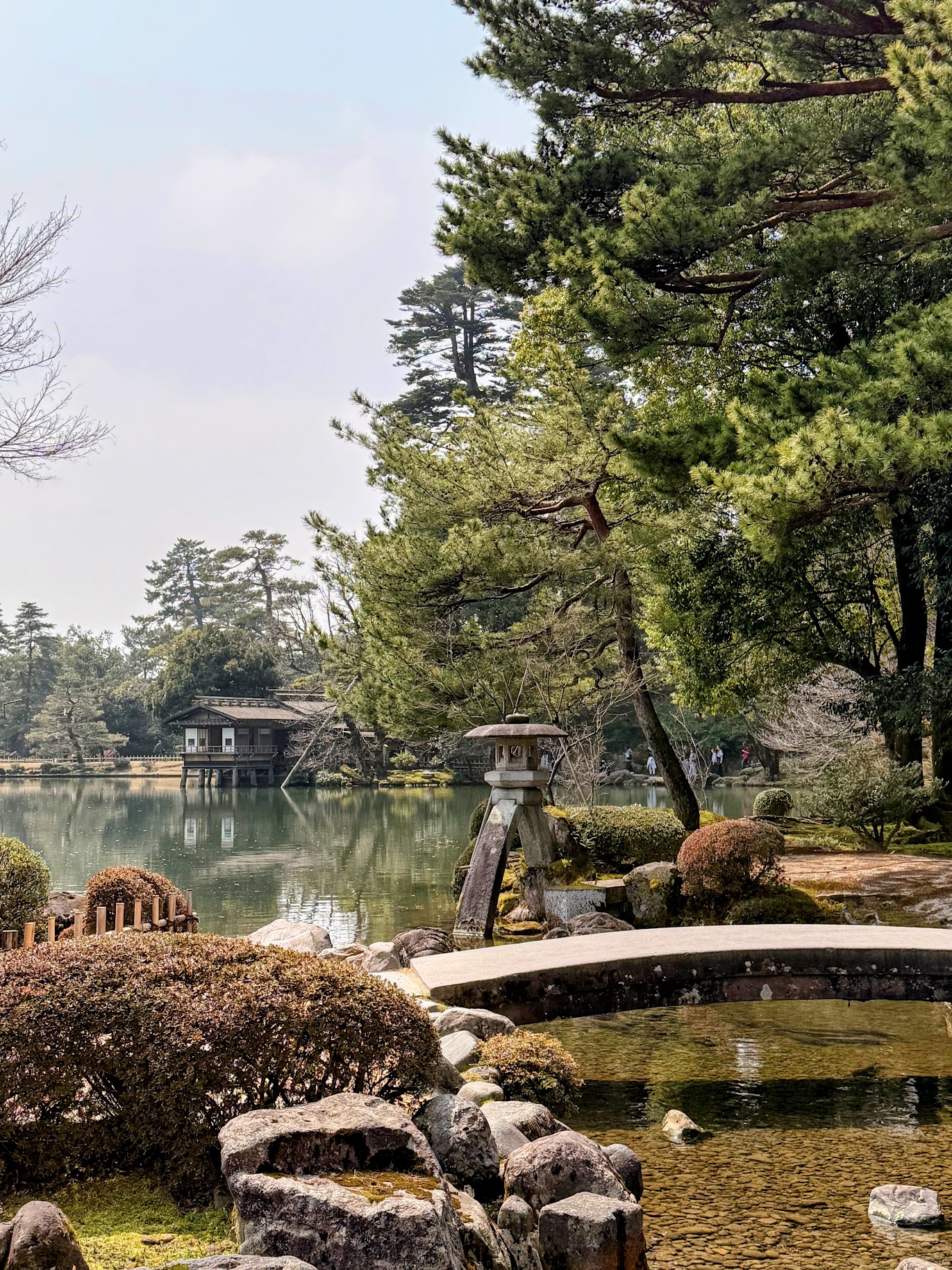
Kenrokuen (兼六園) is consistently ranked alongside Kairaku-en (Mito) and Koraku-en (Okayama) as one of Japan’s three great landscape gardens. The name means “combined-six garden”—referring to a Chinese aesthetic theory that the ideal garden must reconcile six difficult contradictions: spaciousness with intimacy, seclusion with openness, artifice with naturalness, antiquity with freshness, water with panoramic views.
Most Japanese gardens sacrifice some of these qualities for others. Kenrokuen, developed across two centuries by successive Maeda lords, was explicitly designed to achieve all six simultaneously. Whether it succeeds is a matter of taste, but the ambition is visible in every compositional decision.
What to actually look for:
The Kotoji-toro lantern—a two-legged stone lantern standing in the water near the pond’s center—is Kenrokuen’s most photographed object. Its asymmetric legs (one longer than the other) were designed to suggest the bridge of a koto (Japanese zither), referencing classical poetry. It is a visual pun in stone, visible in the garden for over 200 years.
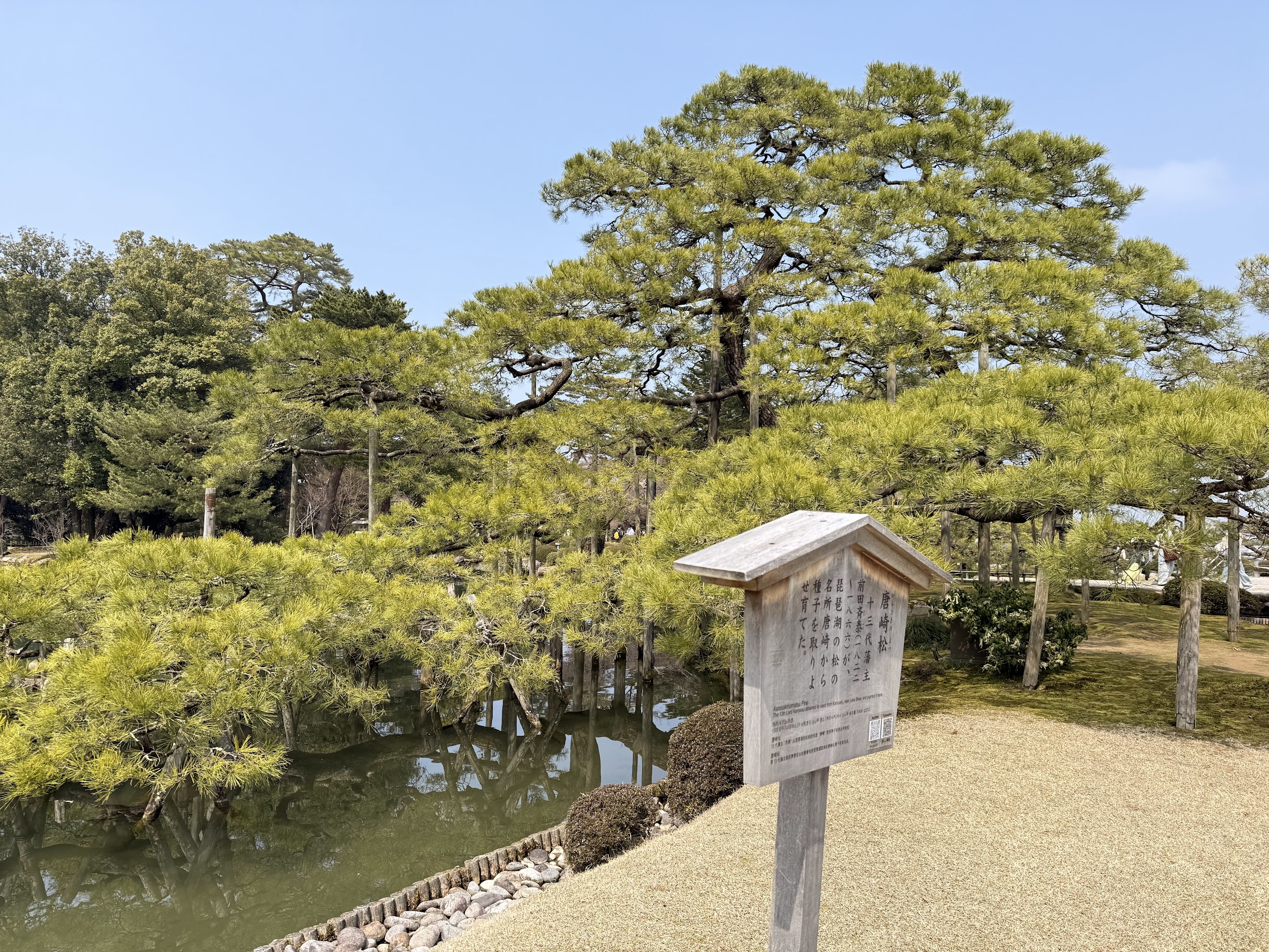
The yukitsuri ropes that appear in winter (roughly November through March) are Kenrokuen’s most distinctive seasonal feature. Hundreds of pine trees in the garden are supported by ropes radiating from a central pole driven into the ground near the trunk—creating an umbrella-like structure that distributes the weight of snow evenly and prevents branch breakage. The technique is aesthetic as well as functional: a garden managed this carefully, through all seasons, is making an argument about the human relationship with nature. Not domination, not abandonment—sustained, attentive care.
Practical note: Arrive at opening (7 AM, free before 8 AM for early-morning visitors) to have the garden largely to yourself. The light in early morning, particularly in autumn, is the light the garden was designed for.
Higashi Chaya District: Reading a Living Geisha Quarter
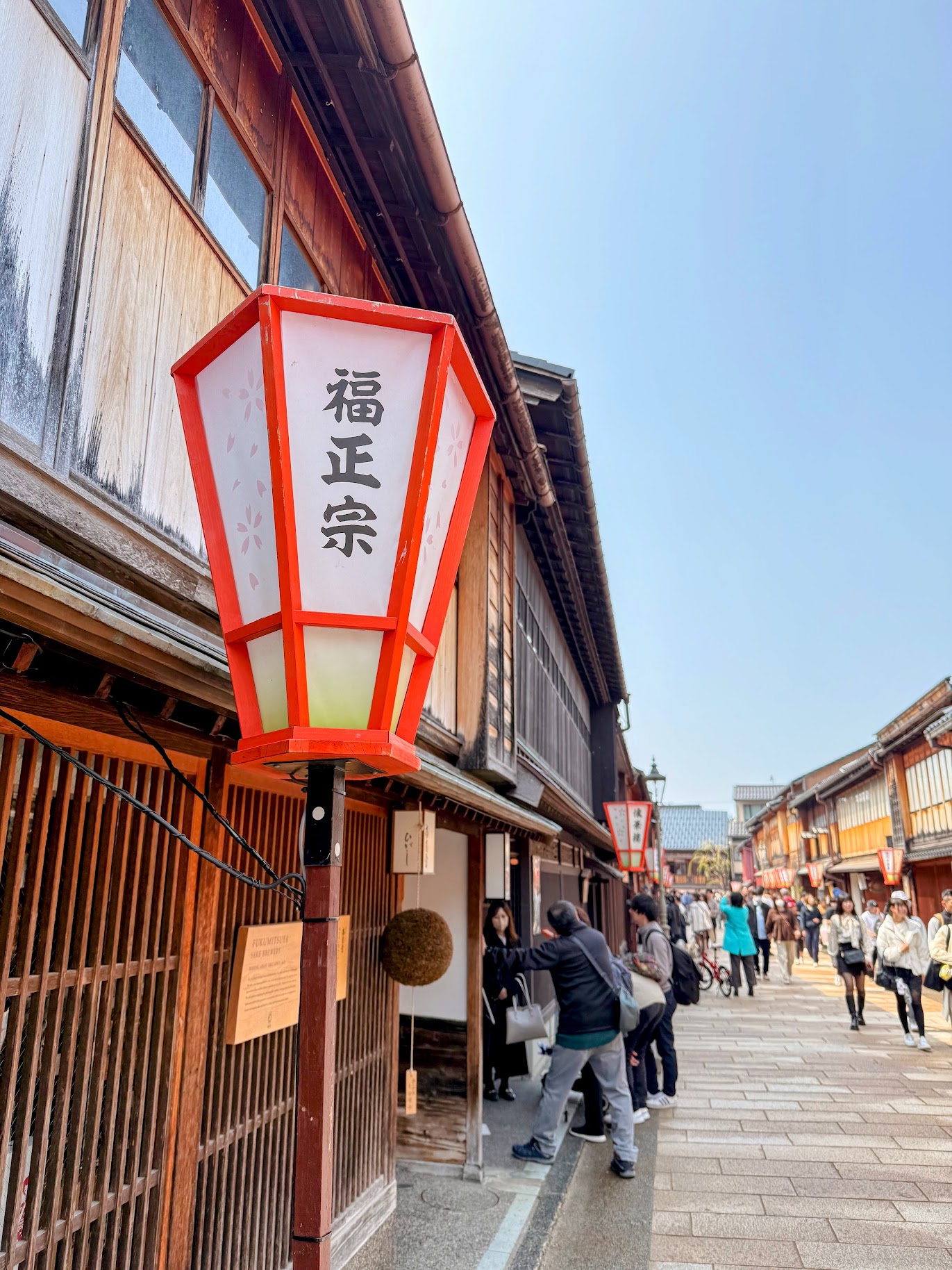
Higashi Chaya (東茶屋街) is one of three chaya (teahouse entertainment) districts that the Maeda clan established in Kanazawa in 1820. The others—Nishi Chaya and Kazuemachi—still exist. Higashi Chaya is the largest and most intact.
The latticework on the facades (kimusuko—wooden grilles that allow those inside to see out without being clearly seen from the street) is the visual signature of chaya architecture. It is not decorative; it is the physical expression of the geisha quarter’s operating logic. The entertainment inside was private and exclusive. The exterior was publicly visible. The lattice mediated between these two worlds.
This is still operating logic. Higashi Chaya has active ochaya (teahouses) where geisha and maiko (apprentice geisha) perform for private clients. You cannot visit these; they require personal introduction. But the neighborhood is not museum-dead—in the early evening, geisha in full dress move through these streets on their way to engagements, exactly as they have for 200 years.
What is open to visitors:
Shima is a preserved ochaya interior, run as a museum since 1985. The rooms—low-ceilinged, perfectly proportioned, floored in tatami with gold-leaf decorated walls—show the architecture of intimate performance. The zashiki (reception room) where a guest and a geisha would spend an evening is smaller than you expect and more beautiful than photographs suggest.
Kaikaro is still an active ochaya that opens its ground floor for tea and sweets during the day. The famous tatami room with tatami woven from gold thread—the most expensive floor covering in Japan—is viewable. Ordering tea here costs around ¥2,000 and is one of the better-value cultural experiences in Kanazawa.
The Nagamachi Samurai District: Architecture of Controlled Power
Nagamachi (長町) is the residential district where middle-ranking Maeda samurai lived. The earthen dobei walls—thick mud-and-straw walls topped with roof tiles—that line the lanes are original. The network of small canals that run alongside them, providing both drainage and subtle defense, is original. Walking Nagamachi requires very little imagination to reconstruct the social world that operated here.
The key thing to understand about samurai residential architecture: it is designed to project status without provoking. The walls communicate wealth and protection but are not aggressive. The gardens visible over the wall tops are carefully maintained but not showy. This is the visual language of a class that had fighting power but was expected, in peacetime, to hold it in reserve.
Nomura Clan Residence (野村家): The most accessible samurai interior in Kanazawa, open daily. The garden—a compact, perfectly balanced composition of stone, water, and carefully shaped trees—was described by a Michelin inspector as one of the finest small gardens in Japan. The interior rooms contain original screens painted by Kano school artists. The experience of sitting on the veranda of a samurai residence and looking at this garden, in the afternoon light, is one of the more unexpectedly moving things Kanazawa offers.
Gold Leaf and the Craft Workshops: Kodawari Made Visible
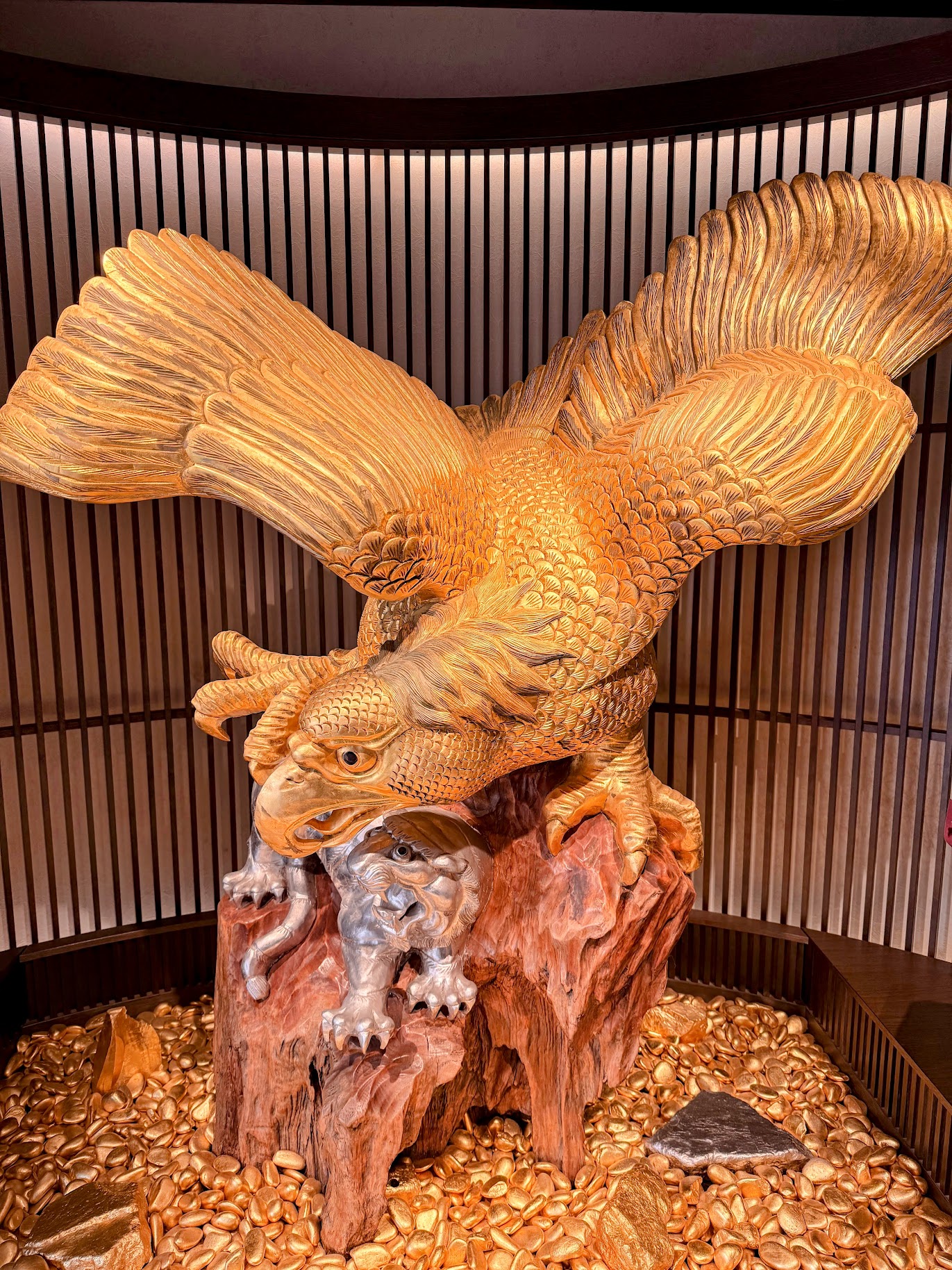
Kanazawa produces over 99% of Japan’s gold leaf (kinpaku). This statistical dominance is not a recent industrial development; it is the accumulated result of Maeda patronage—gold leaf was used extensively in the lacquerware, ceramics, temple decoration, and textiles the clan sponsored, and the craftspeople who produced it concentrated in Kanazawa and never left.
The process of making kinpaku requires beating gold foil between layers of special paper until it reaches a thickness of approximately 0.0001mm—thin enough that a single breath will destroy a sheet. This requires particular atmospheric conditions (Kanazawa’s humid climate, produced by its position between the Japan Sea and the mountains, is conducive to gold leaf work) and years of training to execute.
At Hakuichi (the most visitor-friendly gold leaf workshop/shop near Higashi Chaya), you can try applying gold leaf to small objects yourself—chopsticks, a hand mirror, a small lacquerware box. The experience takes about 20 minutes and costs around ¥1,500–¥2,500. What it communicates, more than any finished product, is the extreme fragility and the extreme patience the work requires. You will gain immediate respect for the craftspeople who do this at professional quality.
The gold leaf ice cream—soft-serve wrapped in a sheet of edible gold leaf—is sold throughout the Higashi Chaya area and is photographed constantly. It is also genuinely good soft-serve, because the milk base is Hokuriku dairy quality.
21st Century Museum: The Argument That Tradition and Contemporary Art Belong Together
In 2004, the city of Kanazawa opened the 21st Century Museum of Contemporary Art (金沢21世紀美術館) in a low, circular glass building designed by architects Kazuyo Sejima and Ryue Nishizawa (SANAA). The building has no main entrance and no back—every side faces outward, every approach is equally valid. The museum is designed to be entered from any direction, like a public park rather than an institution.
The decision to build a world-class contemporary art museum in a city famous for Edo-period crafts was not accidental. It was a statement: that the tradition of mono-zukuri (the making of things with extraordinary care) that runs through Kanazawa’s craft history and the tradition of mono-zukuri that runs through serious contemporary art are the same tradition, expressed in different idioms and centuries.
Leandro Erlich’s The Swimming Pool: The museum’s most famous permanent installation places visitors in a scenario where they appear to be standing underwater while others walk above them (or vice versa) through an ingeniously simple optical construction. Advance tickets required for the underground section (book at the museum website before your trip; it sells out). The free outdoor portion is viewable without tickets and remains striking.
The permanent collection and rotating exhibitions here are genuinely international in quality. The museum is not a tourist attraction adjacent to a craft city; it is a serious contemporary art institution that happens to exist in a city with extraordinary craft heritage.
Omicho Market: What “Kitchen of Kanazawa” Actually Means
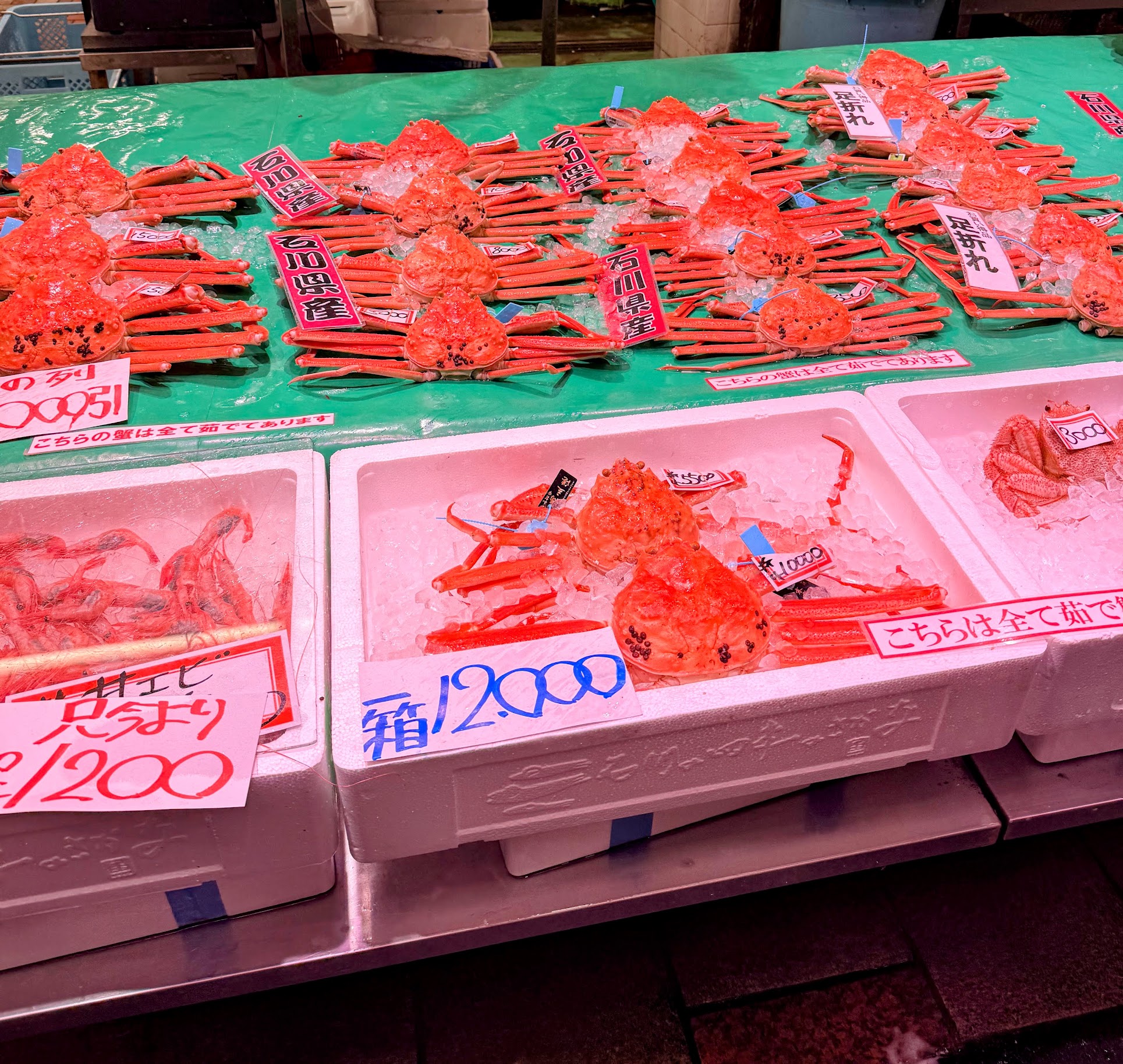
Omicho Market (近江町市場) has operated continuously for roughly 300 years. It is not a tourist market with reconstructed atmosphere; it is the actual wholesale and retail seafood, vegetable, and grocery market that Kanazawa’s restaurants and households use.
The seafood arrives from the Japan Sea coast—specifically from the Noto Peninsula and the ports at Wajima and Nanao. The Japan Sea produces different species than the Pacific: nodoguro (blackthroat seaperch, a premium fatty white fish that Kanazawa has made into a regional luxury), buri (yellowtail), Echizen crab (zuwaigani from the Fukui side) and snow crab, and in summer, ika (squid) pulled from inshore waters.
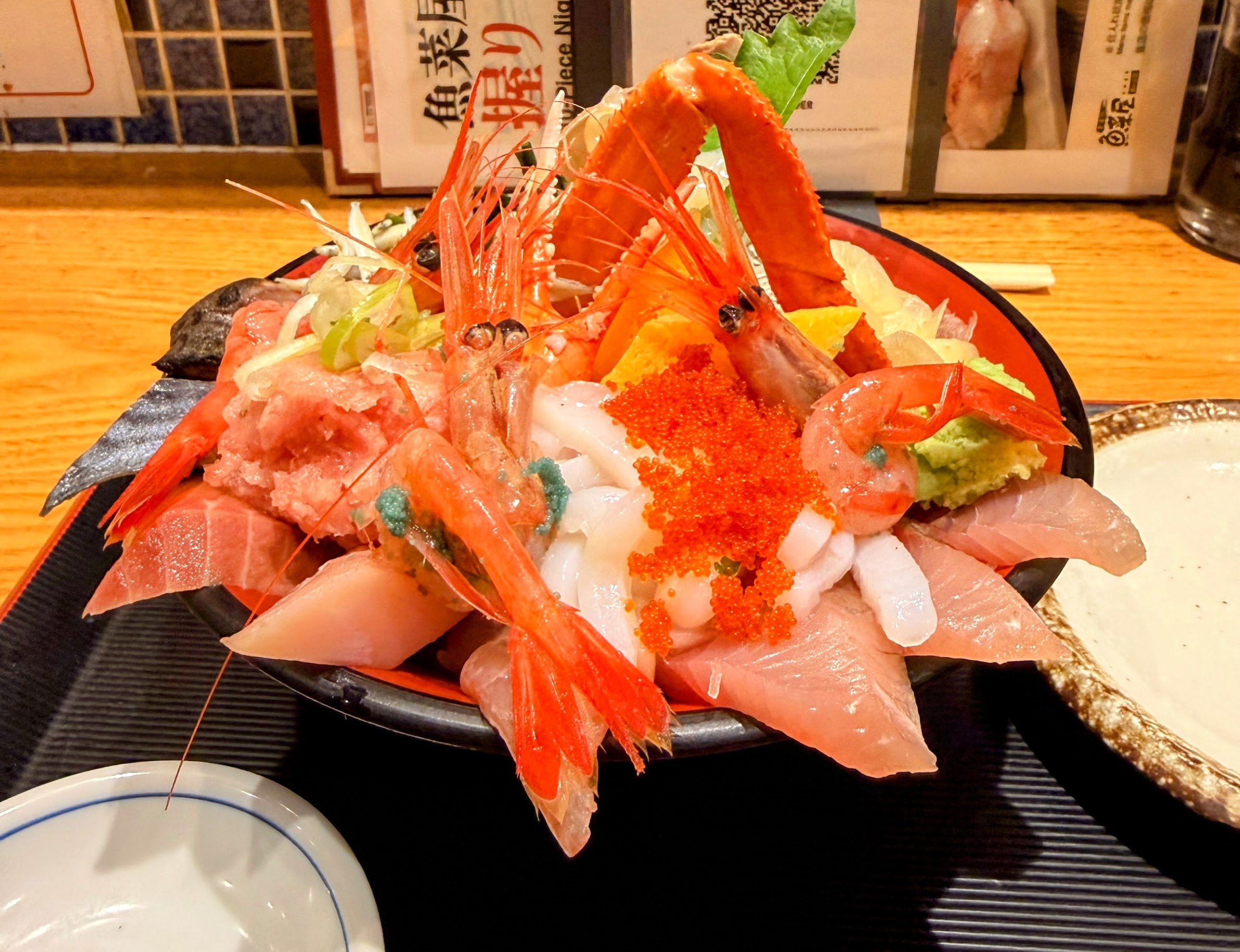
Nodoguro (ノドグロ): If you eat one thing in Kanazawa, eat nodoguro. The fish has a fat content approaching tuna belly (toro) but a lighter, more delicate flavor. It is consumed raw as sashimi, grilled, or in a kaisendon (rice bowl). At Omicho, you can have it in a bowl for around ¥2,000–¥3,000 at one of the small restaurants inside the market building. Japanese food critics consider Kanazawa’s nodoguro among the best single-ingredient experiences available anywhere in the country.
Kaiten-zushi around Kanazawa Station: Kanazawa’s conveyor-belt sushi uses Japan Sea fish that do not appear in Tokyo kaiten-zushi. The quality gap between Kanazawa kaiten-zushi and its Tokyo equivalent is large enough that regular visitors to Japan specifically mention it. Budget around ¥2,000–¥3,000 per person.
Myoryuji: The Temple Whose Complexity Is the Point
The Myoryuji Temple (妙立寺)—known as Ninja Temple though it has no historical connection to ninja—is a Nichiren Buddhist temple built in 1643 that Maeda Toshitsune designed as an emergency refuge. The building contains 23 rooms, 29 staircases, blind corridors, hidden staircases, a well with an escape tunnel to the castle, rooms that appear to be one story from the outside and are three stories inside, and a trapdoor above the main altar.
None of this was designed for entertainment. It was designed for survival—a safe house for the Maeda lord if the castle fell. The “ninja” designation is tourist shorthand for architecture of genuine historical paranoia.
Advance reservation is mandatory—the temple accepts only guided tours and turns away walk-ins. Book through the official website (Japanese language; assistance from your hotel concierge is helpful). Tours run in Japanese with laminated English-language explanations.
Getting There and Moving Around
From Tokyo: Hokuriku Shinkansen (Kagayaki limited stop: 2.5 hours; Hakutaka: 3 hours) from Tokyo Station direct to Kanazawa. The extension to Tsuruga opened in 2024, making Kyoto/Osaka connections by Shinkansen now available (approximately 2 hours from Osaka via Tsuruga transfer).
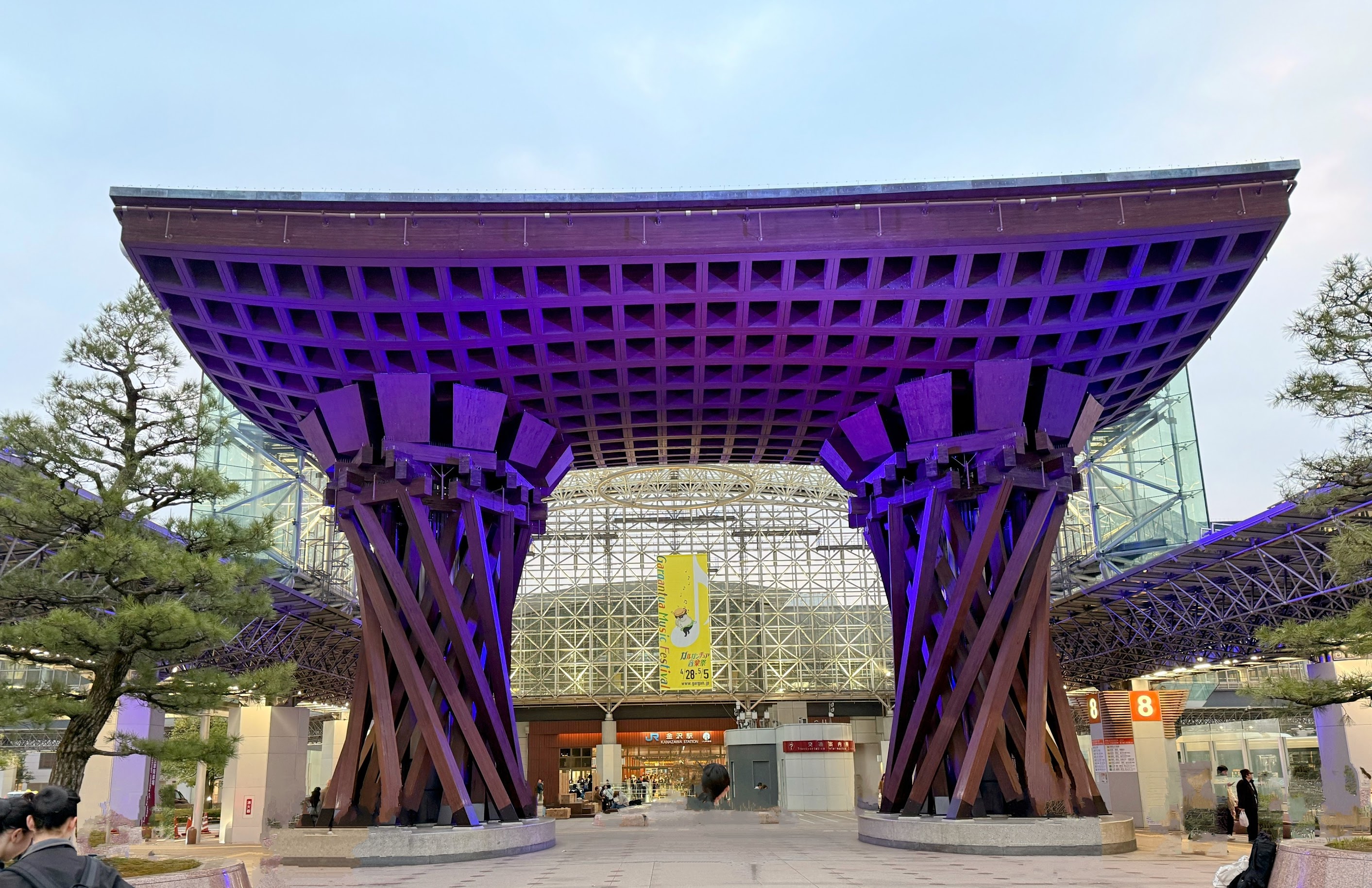
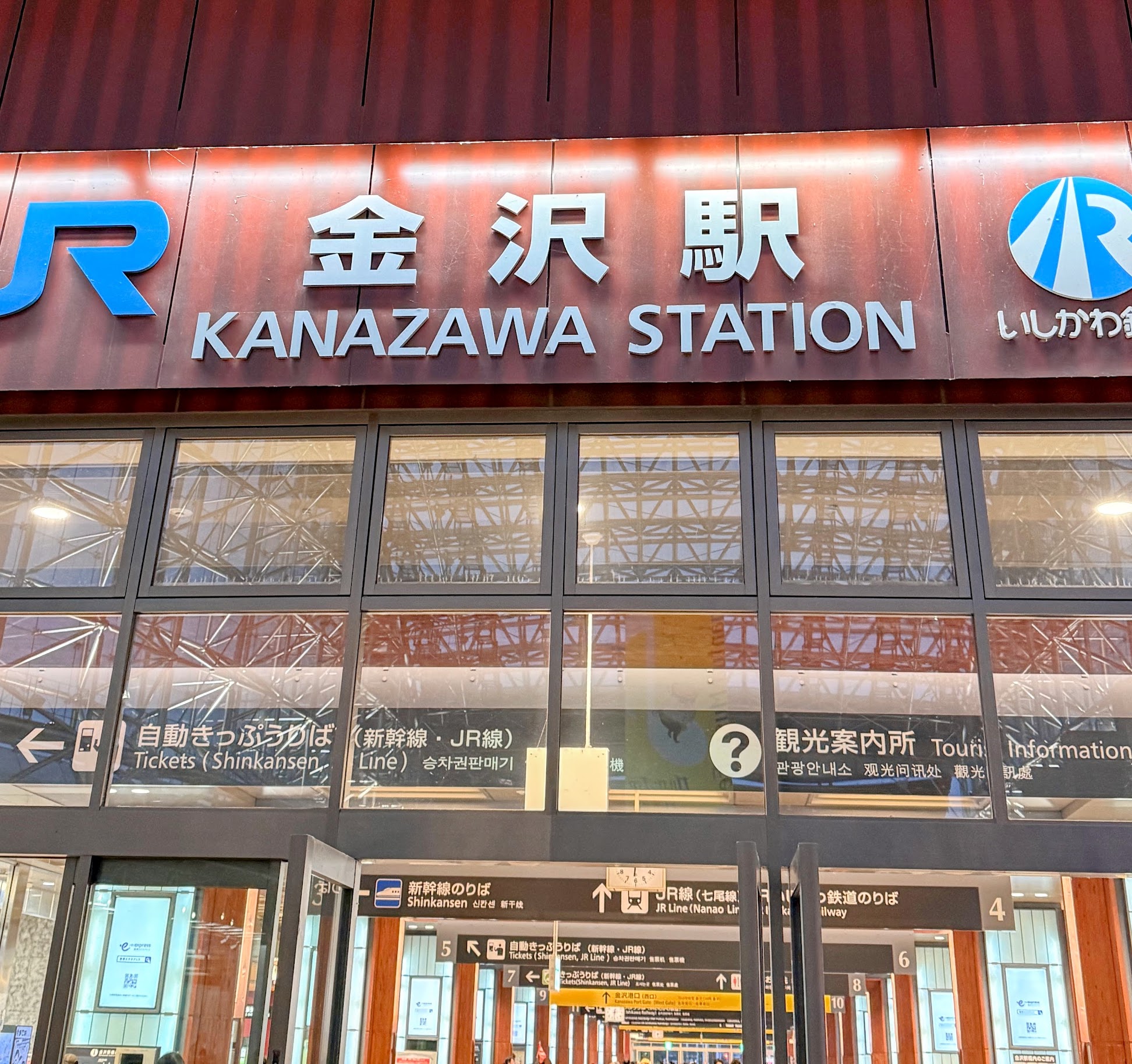
Kanazawa Station: The Tsuzumi-mon gate—two massive wooden structures shaped like hand drums (tsuzumi)—and the glass Motenashi Dome (hospitality dome) facing them are among the most architecturally significant station buildings in Japan. They were designed to communicate Kanazawa’s craft identity on arrival.
Getting around: The Kanazawa Loop Bus (100 yen per ride, unlimited day pass ¥600) connects the station to all major sights. The city is walkable between the main cultural areas (Kenrokuen, Higashi Chaya, Nagamachi) with 15–20 minutes on foot between each. The best experience is walking, because the streets between the destinations are themselves worth seeing.
Time required: Two full days minimum to see the core sights without rushing. Three days allows the addition of the Noto Peninsula (a day trip that requires a rental car and reveals a completely different, coastal version of Ishikawa prefecture).
Kanazawa rewards the visitor who arrives knowing that nothing here needs to be performed or performed for. The geisha quarters function. The craft workshops function. The market functions. The garden is maintained to the same standard it has been maintained for two centuries. The city’s relationship with its own continuity is so settled and so deep that it doesn’t require your attention to validate it—which is, paradoxically, the quality that makes it most worth your attention.