The garden has a name that contains a philosophical problem.
Kenrokuen — written 兼六園 — means “combined-six garden,” a reference to an 11th-century Chinese aesthetic text identifying six qualities the ideal garden must possess: spaciousness, seclusion, artifice, naturalness, water, and panoramic views. The problem is that these qualities are in tension by definition. A garden large enough to feel spacious cannot simultaneously offer seclusion. Water draws the eye downward; panoramic views require height.
The Maeda lords who built Kenrokuen over two centuries — from the late 17th through the early 19th century — were aware of this. Whether the garden solves the problem is a question worth carrying when you visit. Most visitors arrive with cameras and leave with photographs. The more interesting question is what the effort reveals about why this garden exists at all.
What Makes Kenrokuen Worth Visiting
A garden built to demonstrate wealth — not spend it on weapons
The Maeda clan ruled the Kaga domain from Kanazawa Castle for nearly three centuries. With an annual rice yield of one million koku, they were the wealthiest feudal lords in Japan outside the Tokugawa shogunate — and under constant surveillance for any sign of military ambition. The Tokugawa regime would not tolerate a powerful rival. The Maeda response, sustained across generations, was to redirect every surplus into culture.
Kenrokuen was the private garden of Kanazawa Castle, accessible only to the Maeda family until the Meiji Restoration opened it to the public in 1871. For two centuries, successive lords added, rebuilt, and refined it — not as recreation, but as demonstration. A garden of this scale required wealth. Wealth that was explicitly not being spent on soldiers.
Understanding this changes how the garden reads.
The yukitsuri ropes are not decoration
Each November, workers install wooden poles beside every significant pine tree in the garden, running dozens of rope supports radially from the pole’s top to the branches below — creating structures that look, from a distance, like inverted parasols. The function is practical: Kanazawa receives heavy snowfall, and the ropes distribute accumulated snow weight evenly, preventing branch breakage.
But the yukitsuri are also an aesthetic statement. The precise geometry of each arrangement — calibrated to the specific spread of a specific tree — is not concealed. It is displayed. A garden maintained this attentively through every season, including the ones most visitors skip, is making an argument: that sustained care over generations is itself a form of beauty.
Visitors who photograph the yukitsuri as pure visual curiosity are looking at the structure without reading it. The ropes are not decorative. Treating them as decoration is like photographing the roof of a cathedral while missing the liturgy happening inside.
The Kotoji lantern contains a literary joke
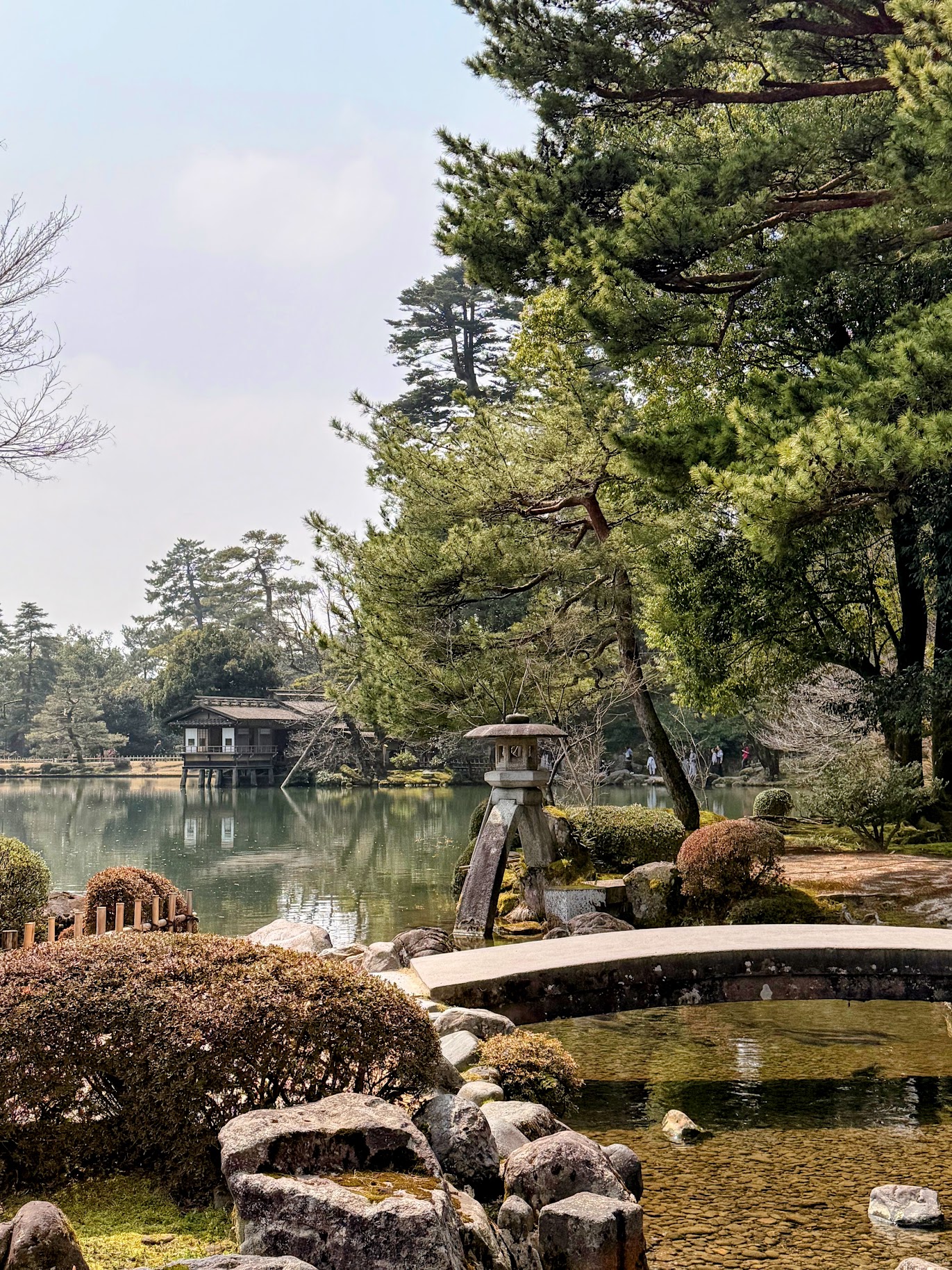
The Kotoji-toro, the two-legged stone lantern standing in the water near the garden’s center, appears in nearly every photograph of Kenrokuen ever taken. Its legs are asymmetric — one longer than the other — a detail most visitors notice without understanding. The discrepancy was intentional: the legs were shaped to suggest the bridge of a koto (Japanese zither), referencing classical poetry and the Heian-era cultural world the Maeda aspired to. It is a visual pun in stone, comprehensible only to visitors who know enough to get the joke.
This is Kenrokuen’s permanent condition. The garden is full of references that reward knowledge and disappear without it.
Getting There
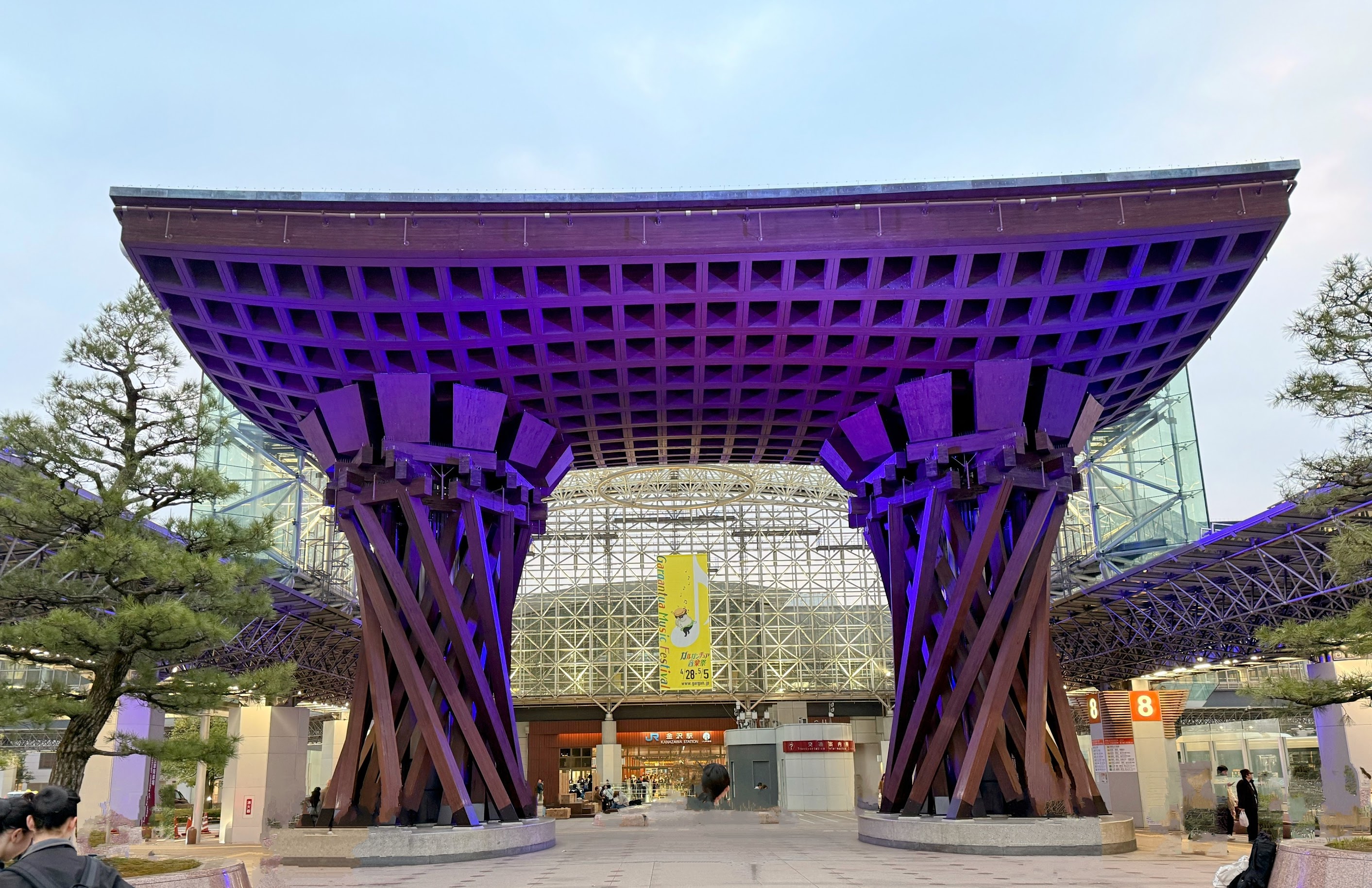
From Tokyo Take the Hokuriku Shinkansen (Kagayaki or Hakutaka) from Tokyo Station to Kanazawa Station — approximately 2 hours 30 minutes. This is the most direct connection. Rail Pass holders: the Hokuriku Shinkansen is fully covered by the Japan Rail Pass.
From Osaka / Kyoto Take the JR limited express Thunderbird or Raicho from Osaka (Shin-Osaka Station) or Kyoto Station to Kanazawa — approximately 2 hours from Osaka, 1 hour 45 minutes from Kyoto.
Kanazawa Station → Kenrokuen From Kanazawa Station’s east exit, take any Hokutetsu bus bound for Kenrokuen-shita (兼六園下). Journey time: approximately 15 minutes. Fare: ¥220 one way. JR buses also run the same route (¥210, covered by Japan Rail Pass). Alight at Kenrokuen-shita bus stop — the main garden entrance is a 3-minute walk.
Walking from the station is possible (approximately 30 minutes) and passes through Kanazawa’s Higashi-Chaya geisha district if you adjust the route.
What to Expect
Kenrokuen covers 11.4 hectares across a hillside, laid out around two central ponds fed by a canal originating from the Tatsumi River. Moss carpets the ground under ancient pines. Around 420 cherry trees bloom in April. Plum (ume) blossoms come in February — earlier than the tourist season, and worth planning around.
At peak season — cherry blossom in April, autumn colour in November — the garden moves between 10,000 and 20,000 visitors per day. Tour buses park in ranks at the base of the hill. The main paths fill early.
The garden rewards patience more than crowds do. At the busiest moments, it is still possible to find quiet at the garden’s western edges, near the Yamazaki-yama hill section, which most visitors bypass in favour of the central pond loop.
Local Tips
Arrive before 8 AM — entry is free and the garden is quiet Kenrokuen opens at 7:00 AM from March through mid-October (8:00 AM the rest of the year). Early morning entry through the Mayumizaka or Katsurazaka gates is free — no ticket required. The garden was designed for morning light, particularly in autumn, when low sun comes through the maple canopy at angles the composition assumes. What looks adequate at noon looks like a different garden at 7:15.
Walk counter-clockwise Conventional tour groups move clockwise, with the Kotoji lantern as an early landmark. Walking against this flow means encountering the garden’s spatial reveals in reverse — producing an entirely different sense of its proportions.
Go in November, not April The cherry blossom is genuinely beautiful but it is also the moment when the garden most resembles a postcard of itself. The post-yukitsuri November garden — ropes up, crowds thinned, the last maples at full colour — is the version that reveals the garden’s actual character. It is colder and less photogenic. It is also more true.
Don’t skip Seisonkaku Villa Immediately adjacent to the garden’s southeast edge, Seisonkaku Villa is missed by the majority of visitors. Built in 1863 by Maeda Nariyasu as a retirement residence for his mother, it is a 19th-century aristocratic interior in near-original condition — lacquerware, painted screens, rooms that show how the same aesthetic sensibility that shaped the garden was expressed inside a building. A combined ticket (Kenrokuen + Seisonkaku) costs ¥950. Allow 40 minutes. It will give the garden’s compositional principles a human context they lack from the paths alone.
Practical Info
| Item | Detail |
|---|---|
| Hours | Mar–Oct 15: 7:00–18:00 / Oct 16–Feb: 8:00–17:00 |
| Early entry (free) | Before regular hours via Mayumizaka or Katsurazaka Gate |
| Admission | Adults ¥320 / Children (6–17) ¥100 / 65+ free |
| Combo ticket | Kenrokuen + 1 site: ¥500 |
| Seisonkaku combo | Kenrokuen + Seisonkaku Villa: ¥950 |
| Closed | Open year-round |
| Bus from station | Hokutetsu bus ~15 min, ¥220 / JR bus ¥210 (Rail Pass valid) |
| Best seasons | Late November (yukitsuri up) / February (plum blossom) |
| Avoid | Golden Week, cherry blossom weekends in April |
The Maeda lords spent two centuries trying to achieve six things simultaneously in a single space. The garden remains open if you want to see how far they got.
Come early enough to have part of it to yourself. Walk slowly. The garden was not built to be photographed in passing.