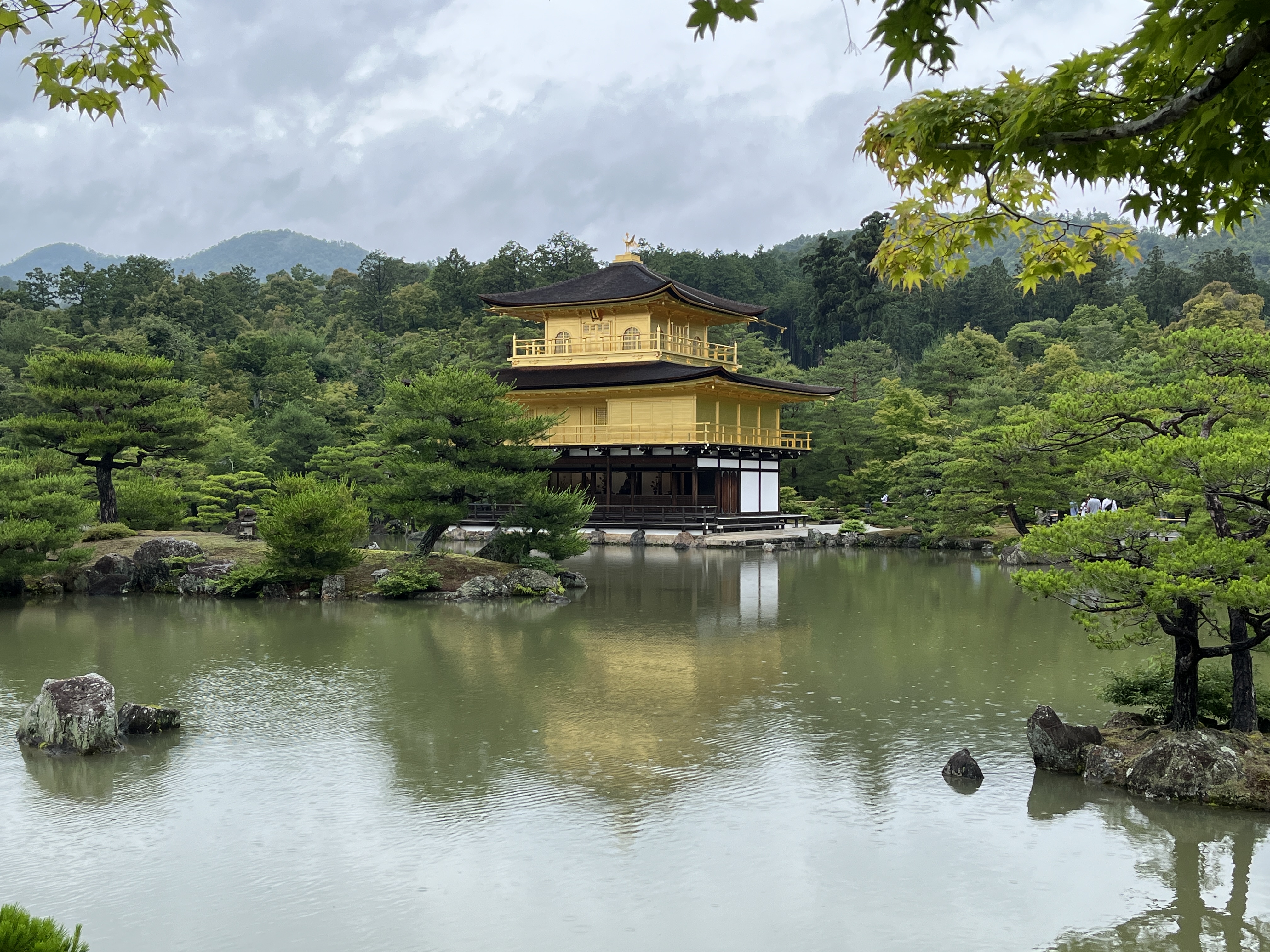
In 1950, a 22-year-old novice monk named Hayashi Yoken set fire to Kinkakuji and burned it to the ground.
He survived. The pavilion did not.
During his trial, Hayashi was asked why he did it. His answer has been interpreted many ways over the decades, but the most honest reading is this: he had become so obsessed with the pavilion’s beauty that it had consumed his ability to think about anything else. He destroyed it, he said, because he believed it had become an obstacle to enlightenment—his own and, he felt, the world’s.
The novelist Mishima Yukio turned this story into one of the most celebrated novels in postwar Japanese literature. The philosopher’s question embedded in that act of arson—can beauty become a trap?—has never stopped being relevant in Kyoto.
I think about Hayashi every time I visit Kinkakuji. Because the danger he identified has not diminished. If anything, in the age of social media, it has intensified.
What Kinkakuji Actually Is (Beyond the Postcard)
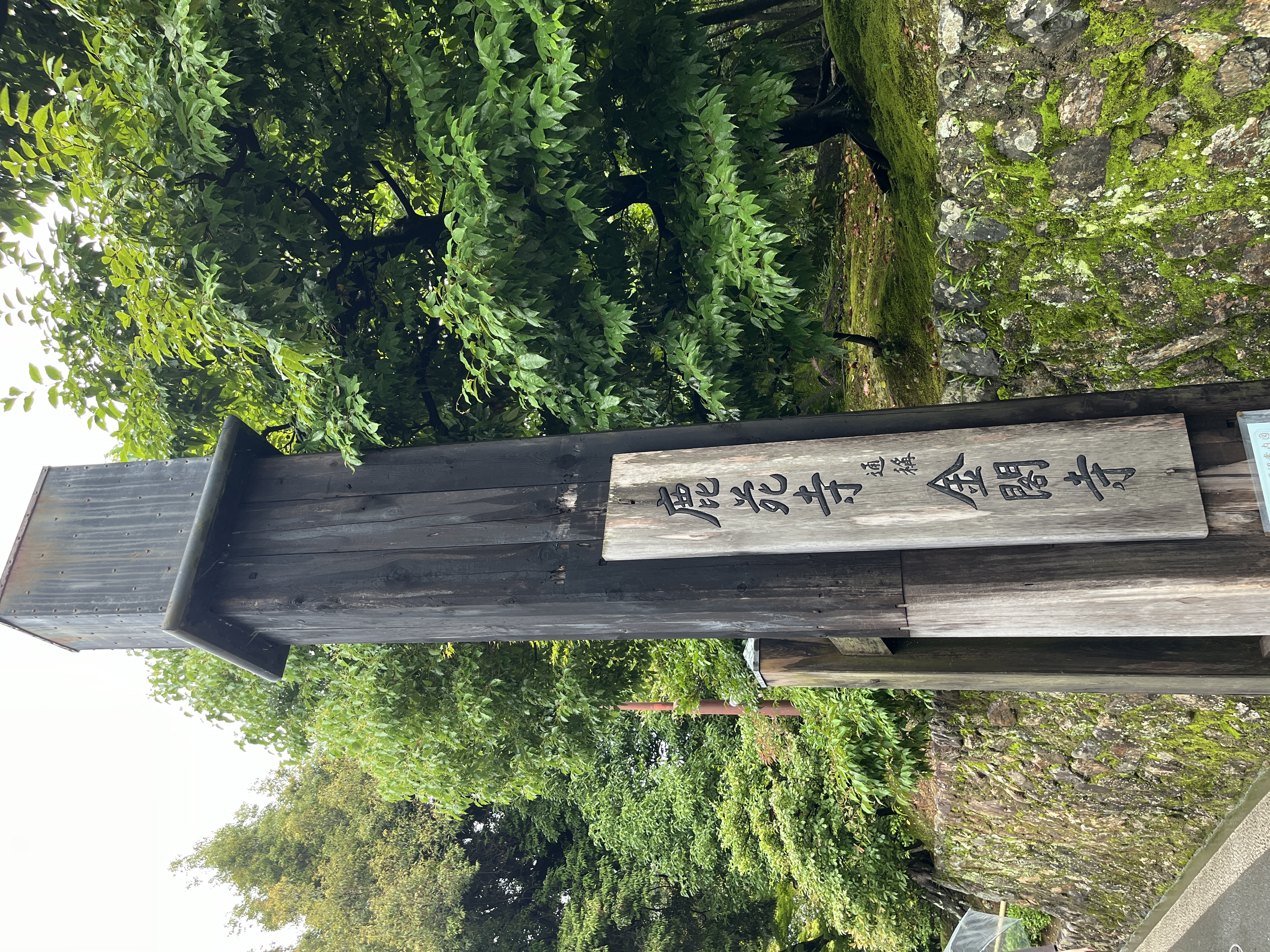
Kinkakuji (金閣寺), officially named Rokuon-ji, is a Zen Buddhist temple in northern Kyoto. Its upper two floors are covered entirely in gold leaf—approximately 20 kilograms of it in the current structure. The ground floor, which is visible from the garden path, is built in the aristocratic shinden-zukuri style of the Heian court. The second floor is samurai architecture—bukke-zukuri. The third floor is Chinese Zen karayō style. Three architectural periods stacked on top of each other, unified by the gold.
The original was built in 1397 as the retirement villa of Ashikaga Yoshimitsu, the third Ashikaga shogun—arguably the most culturally influential political figure in Japanese history. Yoshimitsu was the man who unified north and south Japan, normalized trade relations with Ming Dynasty China, and patronized the arts to a degree that shaped Japanese aesthetics for centuries. He also had a gift for spectacle: he received the Chinese imperial envoy in this building and had himself announced as “the King of Japan”—a title the emperor, not he, technically held.
After his death in 1408, Yoshimitsu’s son converted the villa into a Zen temple as his father had requested. The building stood for 540 years before Hayashi burned it.
The current structure, rebuilt in 1955 and re-gilded in 1987, is faithful to the original’s appearance but is, in the technical sense, a reconstruction. This matters to some visitors and not at all to others. The garden, however, is original—it was designed by Yoshimitsu himself and has continued to exist as a living landscape for over 600 years.
The Garden Is the Real Teacher
Most visitors photograph the pavilion from the main path near the entrance—the classic reflection shot across Kyōkochi (Mirror Pond)—and then move quickly along the walking route. This is understandable. The pavilion from that angle is genuinely arresting.
But the garden rewards much slower attention.
Kinkakyuchi Pond (the Mirror Pond) is designed according to a principle called shakkei—“borrowed scenery”—in which the surrounding hills and trees become compositional elements of the garden design. When you stand at the classic viewpoint, the mountain in the background is not incidental; it was deliberately incorporated into the design 600 years ago. The pond’s irregular shape was calculated to ensure that the pavilion’s reflection appears complete from the designated viewpoint. Every element of what you see from that spot was intentional.
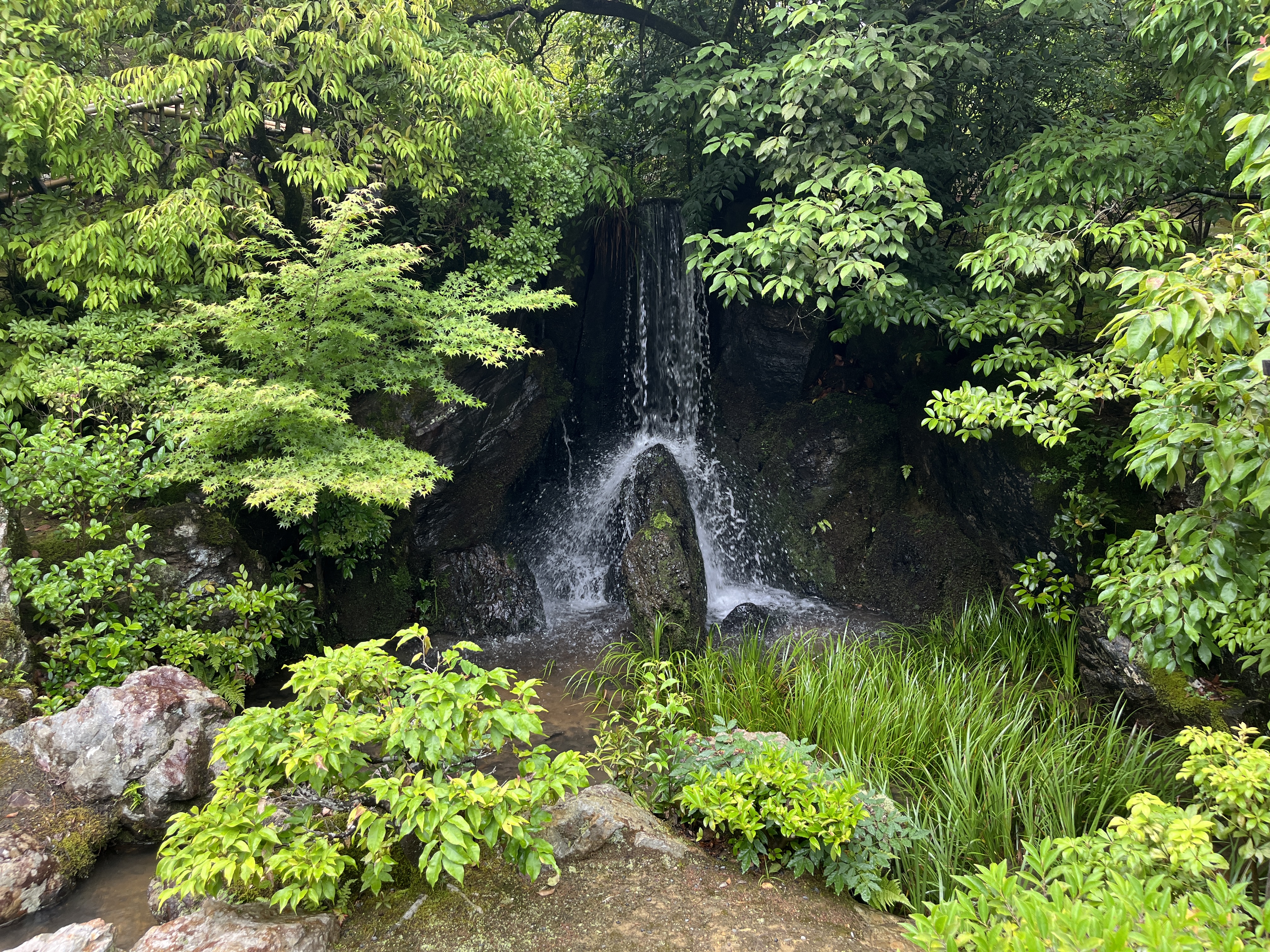
Walk deeper into the garden and the pavilion disappears behind trees. This, too, is intentional. Visibility and concealment are both design tools in Japanese garden-making. The moment when the pavilion reappears from a different angle, the gold catching light between pine branches, is engineered to produce a specific emotional response: the surprise of beauty discovered rather than displayed.
Three Architectural Languages in One Building
Look at the three floors of the pavilion and you are reading three different chapters of Japanese aesthetic history simultaneously.
Ground floor (Hōsuiin): The white plaster walls and natural wood of the Heian aristocratic tradition. This is the aesthetic of the Tale of Genji, of screen paintings and layered silk kimono. Refined, restrained, aristocratic.
Second floor (Chōondo): The warrior’s architecture—more solid, more assertive. This is the aesthetic of the samurai class that displaced the aristocracy but was deeply insecure about that displacement. They built on top of the old forms rather than replacing them.
Third floor (Kukkyōchō): The Zen monk’s ideal—Chinese in inspiration, empty of decoration, all clarity and proportion. The karayō style was associated with the monastery and with enlightenment.
Yoshimitsu deliberately stacked these three systems of meaning. He was making an argument in architecture: that he, the shogun, was the synthesis of all three—aristocrat, warrior, and spiritual aspirant. The golden pavilion was propaganda as aesthetic masterpiece.
Seasonal Light and the Pavilion’s Different Moods
Winter snow is the condition most Japanese people who know Kinkakuji consider its most beautiful. The garden is less crowded, the garden paths are quiet, and if snowfall is recent, the gold pavilion against a white garden and grey sky produces a tonality that the spring and autumn crowds never see. This is wabi-sabi (侘び寂び)—the beauty of imperfection and transience—expressed as weather condition.
Morning light in any season hits the pavilion from the east and makes the gold genuinely luminous rather than merely reflective. The pavilion was designed to face east specifically to capture morning sun across the water. Arriving at opening time (9 AM) before the tour buses arrive is not just a crowd-avoidance tactic—it is the temporally correct way to see the building.
Autumn foliage produces the most photographed version: maples in the garden going orange and red, gold pavilion, blue sky. This is beautiful and true. It is also the most crowded Kinkakuji will ever be.
What the Pavilion Cannot Be Entered
You cannot go inside Kinkakuji. This confuses some visitors who expect museum-style interior access.
The answer is rooted in Zen aesthetics. The pavilion is not designed to be experienced from within. It is designed to be seen from across water, in relationship to garden and sky and mountain. The interior—which contains a statue of Yoshimitsu and various Buddhist relics—would tell you very little that the exterior does not tell you better.
This is also why the single fixed viewpoint near the entrance produces the most satisfying experience: it is the position from which the building makes complete compositional sense. Walk around the building and it starts to look like a construction site viewed from the wrong angle. Beauty, in Japanese aesthetics, is often position-specific. Know where to stand.
The Arson Question, Revisited
When Hayashi burned the pavilion in 1950, he was institutionalized and later died in prison. The literary and cultural debate his act prompted has never quite ended. Was he mad? Was he making a philosophical point? Was the act itself a kind of perverse enlightenment?
The Zen tradition has never given a comfortable answer, because comfort is not what Zen is designed to produce. What the tradition does suggest is this: attachment to beauty—the inability to let beauty exist without needing to possess it, control it, capture it—is a form of suffering.
Every person at Kinkakuji photographing the same reflection from the same angle with the same framing is enacting a very mild version of Hayashi’s obsession. The antidote is not to avoid photography. It is to put the camera down for at least some minutes, stand at the viewpoint, and simply let the pavilion be what it is: 600 years of human aspiration and political theater and genuine art, reflected on water, in a garden designed to make you feel the scale of time.
Practical Information
- Access: Bus 101 or 205 from Kyoto Station to Kinkakuji-michi stop; 5-minute walk
- Hours: 9:00 AM – 5:00 PM daily
- Admission: ¥500 (includes paper temple ticket that doubles as an amulet)
- Best timing: Weekday mornings; winter for snow; January for thin crowds and clear light
- Nearby: Ryoanji Temple (rock garden, 20-minute walk) and Ninna-ji Temple (UNESCO, 15-minute walk) make a natural half-day route
The pavilion was rebuilt after the arson. Of course it was. Japan’s relationship with impermanence—the understanding that things are destroyed and remade, that this is the nature of things—is one of its deepest cultural positions. What matters is not that the structure endures unchanged, but that the knowledge of how to make it, and the desire to preserve what it means, continues.