Tokyo’s Most Useful Contradiction: A Half-Day Guide to Korakuen
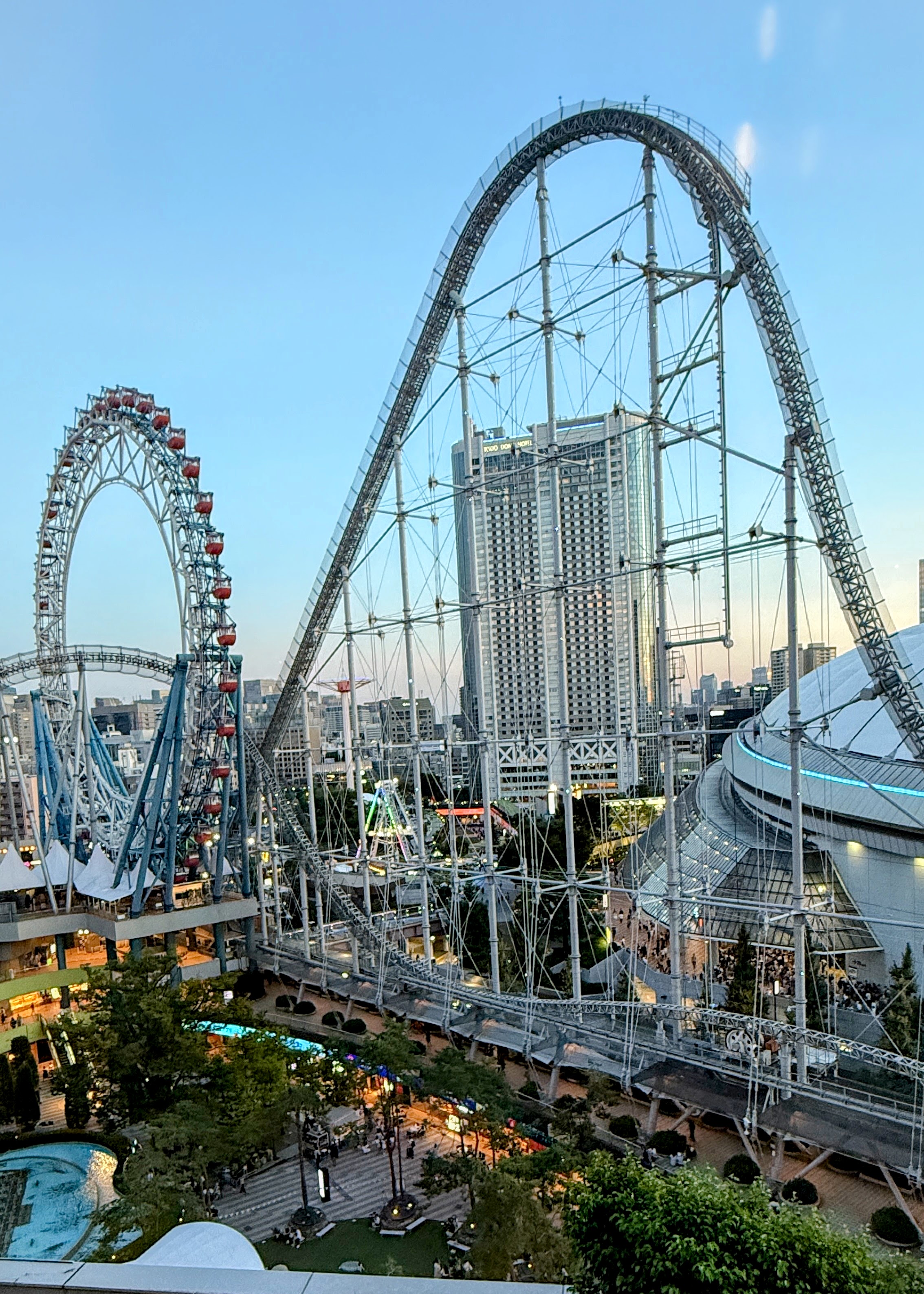
A rollercoaster threads between skyscrapers forty meters overhead. Below it, a 400-year-old pond reflects the clouds. Both are real. Both are Tokyo.
Most visitors to the Korakuen area make a binary choice — baseball game or garden, entertainment or history — and leave half the story unread. This guide is for the ones who want both afternoons in a single morning.
The Contradiction, Up Close
Koishikawa Korakuen Garden opened in the 1660s. Tokyo Dome opened in 1988. They share a fence.
That fence is the most interesting border in the city. On one side: 70,000 square meters of Edo-era landscape design — stone bridges arcing over still water, plum groves that bloom in February when everything else looks dead, maple canopies that catch fire every November. On the other: the Thunder Dolphin rollercoaster threading between buildings at 130 km/h while a karaoke Ferris wheel turns lazily above it all.
Stand in the northern corner of the garden long enough and the bass thud of Tokyo Dome’s sound system becomes indistinguishable from the city’s ambient pulse. You stop filtering it. That’s ma working on you — the Japanese concept of meaningful negative space — operating without your permission.
Garden admission: ¥300. That’s the price of a vending machine coffee for 90 minutes of feudal landscape design. Go first, while your legs are fresh and your phone battery is full.
How to Spend the Day
Morning — Koishikawa Korakuen Garden (90 min) Enter from the south gate nearest Korakuen Station. Take the path counterclockwise — it brings you to the Engetsu-kyo (Full Moon Bridge) early, while the light is still angled and worth photographing. Seasonal highlights: cherry blossoms in late March, iris in June, autumn leaves from late October.
Midday — Tokyo Dome City Attractions (2–3 hrs) Cross through the garden’s east exit and you’re in a different century in under five minutes. The amusement park anchored by the Thunder Dolphin is compact but vertical — the rollercoaster literally passes through a building. The giant Ferris wheel at the center features gondolas with karaoke systems, which sounds absurd until you’re 60 meters up singing off-key to Hikaru Utada with a view of the Bunkyo skyline.
If you’re traveling with young children, Asobono — one of Tokyo’s largest indoor play facilities — is on the fifth floor of LaQua and saves the day when weather turns.
Afternoon — Choose Your Own
Option A: Space Travelium TENQ A planetarium-adjacent experience with immersive projection mapping across domed ceilings. Better than it sounds on paper, especially for the 45 minutes when you realize you’ve been staring upward without thinking about anything.
Option B: Spa LaQua One of Tokyo’s serious natural hot spring complexes, drawing water from 1,700 meters below the city. Saunas, relaxation floors, outdoor baths with the dome in the background. The juxtaposition of soaking in Edo-era water beneath a 21st-century stadium is either deeply strange or exactly right — Tokyo rarely lets you decide which.
Option C: Tokyo Dome (game nights) If the Yomiuri Giants are playing, go. Tickets run ¥1,800 to ¥6,000 depending on seat and opponent. The vendors who sprint up and down the stadium stairs carrying 10-kilogram beer kegs on their backs will pour your cup perfectly without spilling a drop. Tipping doesn’t exist here. Arigatou is the correct response.
The Practical Layer
Getting There Korakuen Station (Tokyo Metro Marunouchi and Namboku Lines) — 3-minute walk to the garden south gate. Suidobashi Station (JR Chuo-Sobu Line) — 5-minute walk to Tokyo Dome City main entrance.
Best Seasons Late March (cherry blossom), early June (iris), late October–November (autumn leaves). The garden is functional year-round; the seasonal layers are what separate a visit from a memory.
Why This Block Exists
Urban planners didn’t intend Korakuen to be a philosophical argument. It became one anyway. The garden wasn’t preserved as a counterweight to the dome — the dome was simply built where land was available, next to what already existed.
Tokyo doesn’t curate its contradictions. It accumulates them, leaves them adjacent, and lets you sort out the meaning.
That’s the work of a half-day here. Not sightseeing — sorting.