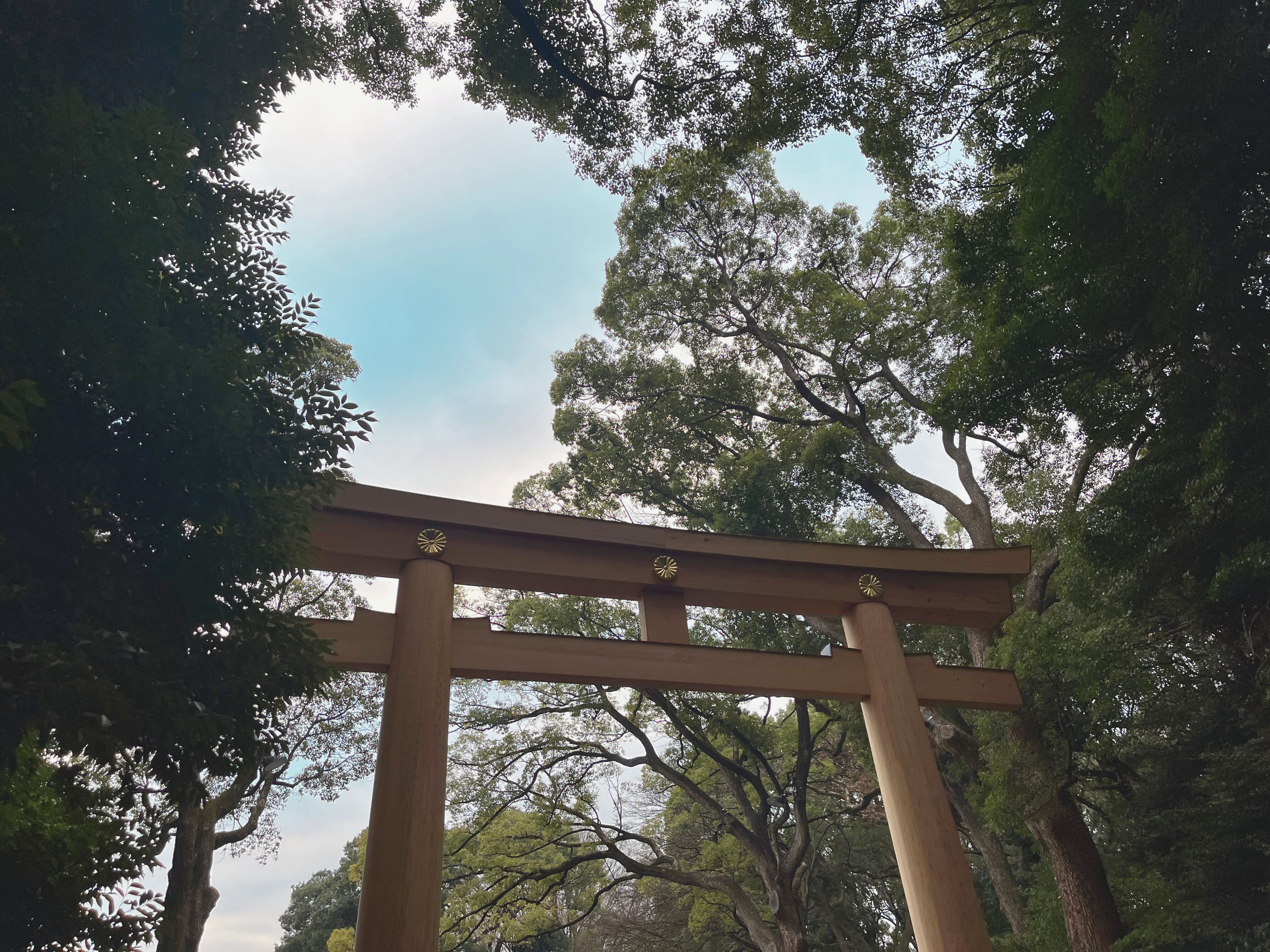
Imagine standing on the Harajuku Bridge. Behind you: the frantic energy of Gen-Z street fashion, Gothic Lolitas, the entire machinery of Japanese pop culture running at full volume. In front of you: a massive timber gate, centuries old in appearance, marking the entrance to 70 hectares of dense forest in the center of a city of 14 million people.
You step through the gate. The city noise drops by roughly half in the first 30 meters. By the time you reach the first bend in the path, Tokyo has effectively disappeared.
This is not an accident. This is engineering.
The Most Ambitious Landscape Project in Modern Japan
Meiji Jingu was built to enshrine Emperor Meiji and Empress Shoken after their deaths in 1912 and 1914 respectively. The Emperor himself had transformed Japan—presiding over industrialization, constitutional government, and the country’s emergence as a modern power—and the decision to dedicate a major shrine in the capital made obvious sense.
What was less obvious was the decision about the forest.
In 1920, the land around the shrine site was largely farmland and pine forest—not particularly impressive or sacred-feeling. The planners faced a choice: use a conventional Japanese garden design with artfully placed specimens, or attempt something far more ambitious. They chose ambition.
A national campaign solicited trees from across Japan and from Japanese communities in Korea, Taiwan, and Sakhalin. 100,000 trees of 365 species arrived. They were planted by 110,000 volunteers who participated in a coordinated nationwide effort over two years. The trees were specifically selected and arranged to create, over time, a self-sustaining climax forest—the kind of dense, dark, multi-canopy woodland that would take centuries to develop naturally.
The plan worked. One hundred years later, the forest is exactly what the designers intended: it looks and feels ancient. The tall zelkovas and camphor trees form a closed canopy. Sunlight reaches the ground in shafts. The undergrowth has developed its own logic. And the maintenance required has dropped to almost zero—the forest now maintains itself.
This is what the Japanese call mirai ni mukete (未来に向けて)—“building toward the future”—in its most literal expression. A generation planted trees they knew they would never see mature, for the sake of people a century later. The forest you walk through today is not the legacy of the shrine. The forest is the shrine.
Walking the Sando: What to Notice on the Approach
The wide gravel path (sando) from the southern entrance to the main hall takes about 10 minutes to walk at a considered pace. Three things along the way are worth stopping for:
The Sake and Wine Barrels
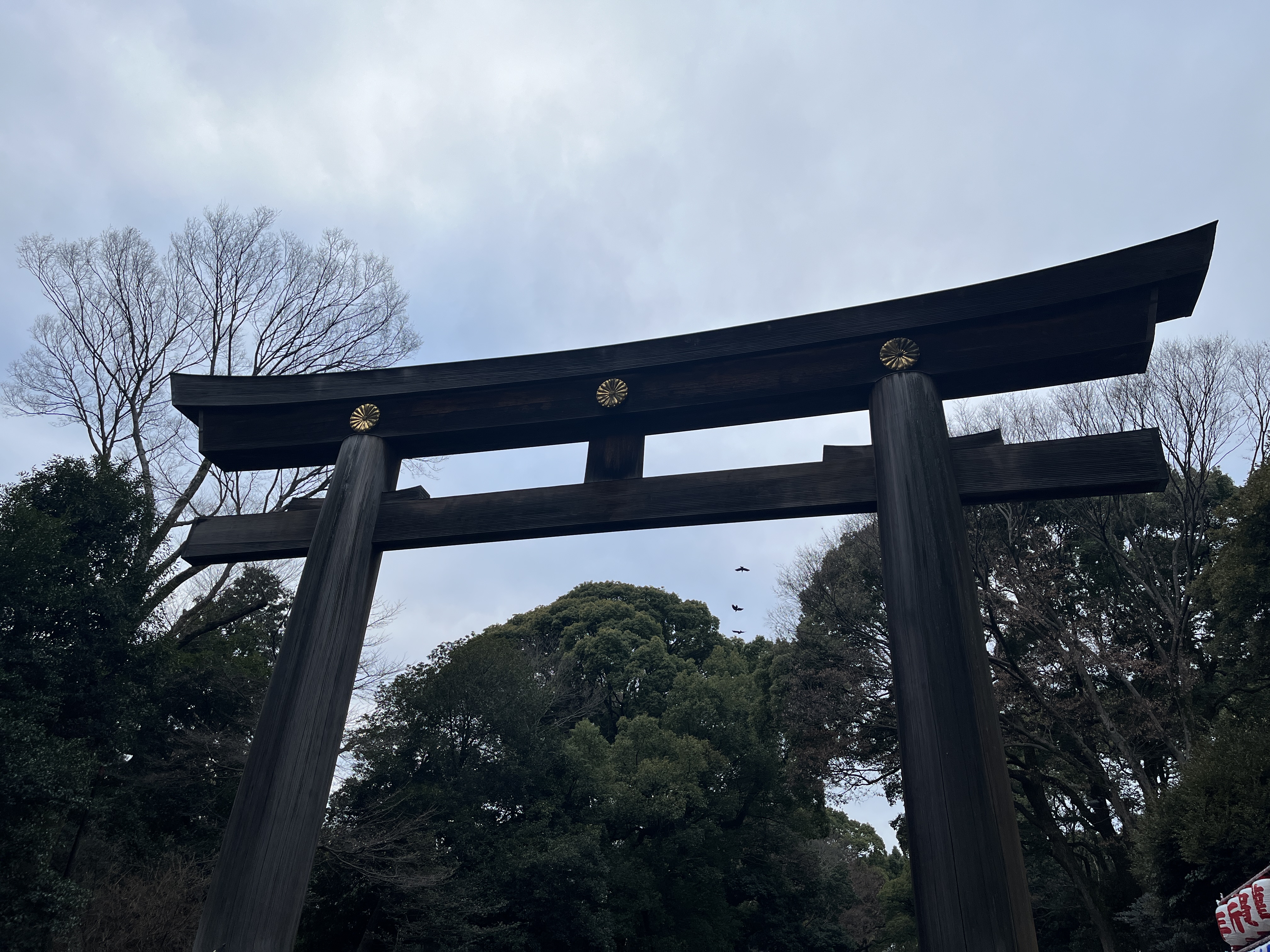
On the right side of the path: rows of kazaridaru—decorative cedar barrels of sake, wrapped in traditional straw, donated annually by sake breweries from across Japan. On the left: barrels of Burgundy wine, donated by the French wine community.
Emperor Meiji was the first Japanese emperor to embrace Western culture systematically—he wore Western suits, ate Western food, hosted Western-style dinners. The wine barrels are not an anomaly or a concession to foreign tourists; they represent what the Emperor actually valued: the idea that Japan could adopt what it found useful from other cultures without abandoning what it already was. Both sets of barrels sit comfortably on the same path, in a forest dedicated to Japanese Shinto, without either contradiction or explanation. That confidence in synthesis is one of the most characteristically Japanese things about this place.
The Grand Torii
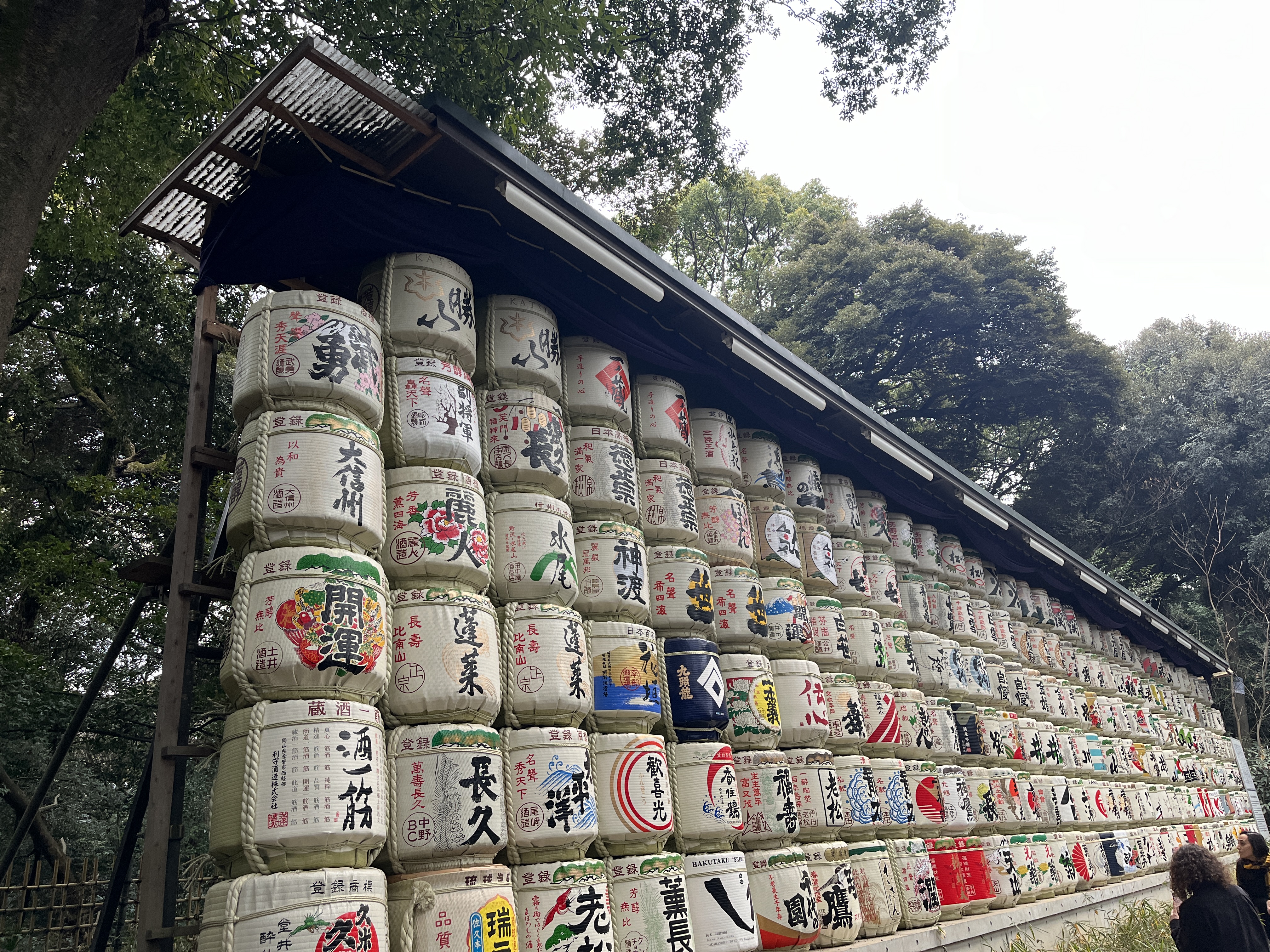
The Ōtorii standing at the junction of the south and north paths is the largest wooden Shinto gate in Japan—12 meters tall, built from a single cypress tree over 1,500 years old that was felled in Taiwan. The timber is so dense and old that it has barely aged in the century since installation.
Stop here. Not to photograph it—though that is fine—but to stand under it and notice the shift in your own consciousness. The gate functions architecturally as a threshold, a marker of transition from one mode of being to another. Many visitors walk through quickly. The more useful approach is to pass through slowly, aware that you are crossing something.
Kiyomasa’s Well and the Inner Garden
For ¥500, the Inner Garden (内苑) is accessible from the main path. In June, the irises—over 150 varieties—are extraordinary. But the more enduring attraction is Kiyomasa’s Well (清正井), a natural spring named after the feudal lord Kato Kiyomasa who is said to have dug it in the early 17th century.
The well is designated a pawā supotto (power spot)—a contemporary Japanese concept borrowed from Western New Age culture but thoroughly domesticated—a place where the earth’s energy is particularly concentrated and accessible. Japanese people take photographs of the well and use them as smartphone wallpaper in the belief that it brings good fortune. Millions of people have done this. Whether you find this credulous or entirely reasonable probably says something about your own relationship with invisible forces.
How to Participate in Shinto Worship
Meiji Jingu is an active place of worship, visited by millions of Japanese people annually for hatsumode (first visit of the new year), shichi-go-san (childhood milestone ceremonies), seijin shiki (coming-of-age ceremonies), and ordinary private prayer. If you want to do more than observe, here is the sequence:
At the Temizuya (purification fountain): Use the provided ladle to rinse your left hand, then your right hand, then cup water in your left palm and rinse your mouth. This is temizu (手水)—ritual purification before approaching the sacred space. The water is cold, the ritual is brief, and it matters.
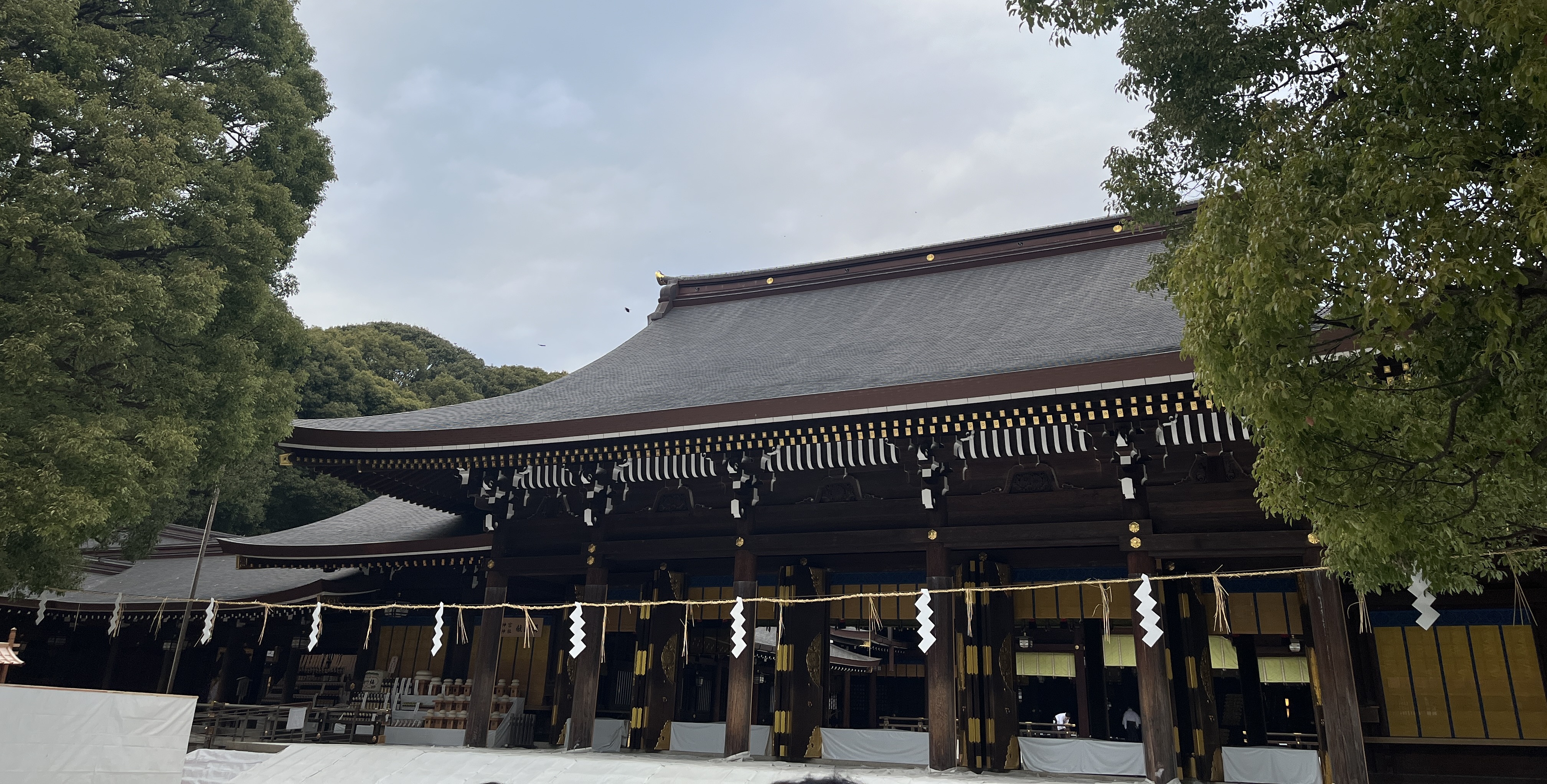
At the main hall: Approach the wooden offering box. Toss a coin—any denomination, though a 5-yen coin (go-en, a homophone for the word meaning “fate” or “connection”) is traditional. Do not throw it forcefully; place or drop it gently. Then: two deep bows, two sharp claps, one silent moment of prayer, one final bow. This is the standard Shinto sequence practiced at virtually every shrine in Japan.
Meiji Jingu’s distinctive fortune: Unlike most shrines, Meiji Jingu does not offer conventional “good luck” or “bad luck” omikuji fortunes. Instead, they offer omigokoro—sacred poems written by Emperor Meiji himself, with English translations. They are not predictions; they are counsel. The subtlety of this distinction is very Japanese.
The Morning: When the Shrine Becomes Itself
The shrine opens at sunrise and closes at sunset. For most of the year, this means opening between 5 and 6:30 AM.
At 7 AM on a weekday, Meiji Jingu has perhaps a few hundred visitors rather than the tens of thousands it will host by midday. The priests conduct morning rituals. The forest sounds—birds, wind, the crunch of gravel underfoot—are not covered by crowd noise. The light comes through the canopy in specific, beautiful ways that disappear once the sun is higher.
Many Japanese people who live near Harajuku visit the shrine before work. They are not tourists. They are performing the same brief ritual they perform every week or every morning, incorporating sacred space into the ordinary structure of their lives in a way that no amount of tourist visiting can replicate but is worth witnessing.
The North Gate: Tokyo’s Best-Kept Exit
Most visitors retrace their steps back to Harajuku after the main hall. Instead, walk north through the North Gate (Kitamon).
The gate opens onto a large grass field—unusual in Tokyo, which has almost no open land—where on weekends you’ll find families with children, joggers, and people eating lunch in the sun. Beyond the field is the Meiji Jingu Museum, designed by architect Kengo Kuma in his characteristic style of wood, stone, and careful restraint. The museum covers the history of Emperor Meiji and contains personal artifacts, photographs, and imperial ceremonial objects.
The exit here puts you in a different neighborhood—away from the commercial noise of Harajuku and closer to the quieter streets of Sendagaya. It is worth deliberately planning your visit as a traversal rather than an out-and-back.
Practical Information
- Access: JR Harajuku Station (Omotesando exit), 2-minute walk; or Meiji-jingumae Station (Tokyo Metro Chiyoda/Fukutoshin Lines)
- Hours: Sunrise to sunset (approximately 5–6:30 AM opening depending on season)
- Admission: Free for shrine; Inner Garden ¥500
- Museum: ¥1,000 adults; closed Thursdays
- Photography: Permitted on approach paths; strictly prohibited inside the innermost sanctuary
The forest was planted in 1920. The trees that felt the effort of 110,000 volunteers are now a hundred years old. Somewhere in their root systems is the ambition and grief and care of people who are long dead, growing silently. You walk through that when you walk through Meiji Jingu. It is worth taking a moment to know it.